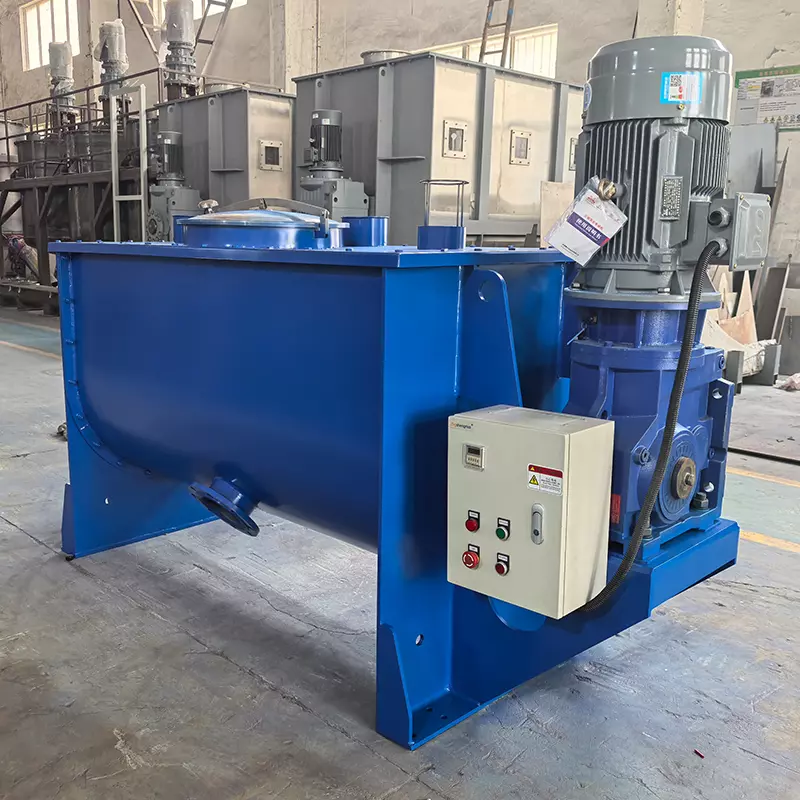
Product Description:
The LHY horizontal helical mixer is widely used in the fields of chemical engineering, medicine, food, and building materials, and can be applied to processes such as the mixing of powders with powders, the mixing of powders with a small amount of liquid, and the mixing of powders with particles.
Technical Specifications:
Processing capacity per batch: 0.1 to 20 cubic meters
Material processed per batch: 0.3 to 15 tons
Mixing time used: 3 to 15 minutes
Material can be made of 316L, 321, 304, or carbon steel
Working principle:
The horizontal screw mixer is mainly composed of a mixing chamber, a stirrer, and a driving device. In the U-shaped tubular chamber, a double-layer counter-rotating stirrer shaft with spiral blades is installed. Under the drive of the external spiral blade, its winding form and rotation direction cooperate to push the material from both ends of the U-shaped chamber towards the central area. The inner spiral blade pushes the material from the middle to both ends, forming a convective mixture. The bottom center of the horizontal cylinder of the mixer is equipped with an outlet. The helical structure of the outer spiral blade cooperates with the rotation direction of the main shaft to drive the material inside the cylinder wall to the central outlet for discharge, ensuring that there are no dead corners for material discharge within the cylinder.
Specification parameters:
1. Determine the volume of each batch of mixed materials, ranging from 0.1 to 20 cubic meters, and select the corresponding specification of equipment.
2. Select the material for the equipment fabrication. The materials are classified as: the parts in contact with the materials, the parts not in contact with the materials, and the other components of the equipment retain the original material. The material is determined based on factors such as the nature of the materials, operating conditions, and hygiene level. Commonly, carbon steel, 304/316L/321 stainless steel materials are selected, and the surface treatment requirements are determined according to the requirements.
3. Determine the driving capacity based on the properties of the materials, such as specific gravity and fluidity, as well as the startup standards. The startup standards are: heavy-load startup and no-load startup.
4. Add auxiliary functional components based on the actual process conditions, such as liquid spraying, heating/cooling, etc.
5. Design the opening requirements of the equipment, such as the feeding port, cleaning port, exhaust hole, etc.
6. Select the discharging mode and driving method, including manual, pneumatic, and electric.
Important Note: The selection of equipment is a crucial step. Please provide as much detailed information about the materials and the process arrangement as possible, so that our professional staff can offer you high-quality technical services.