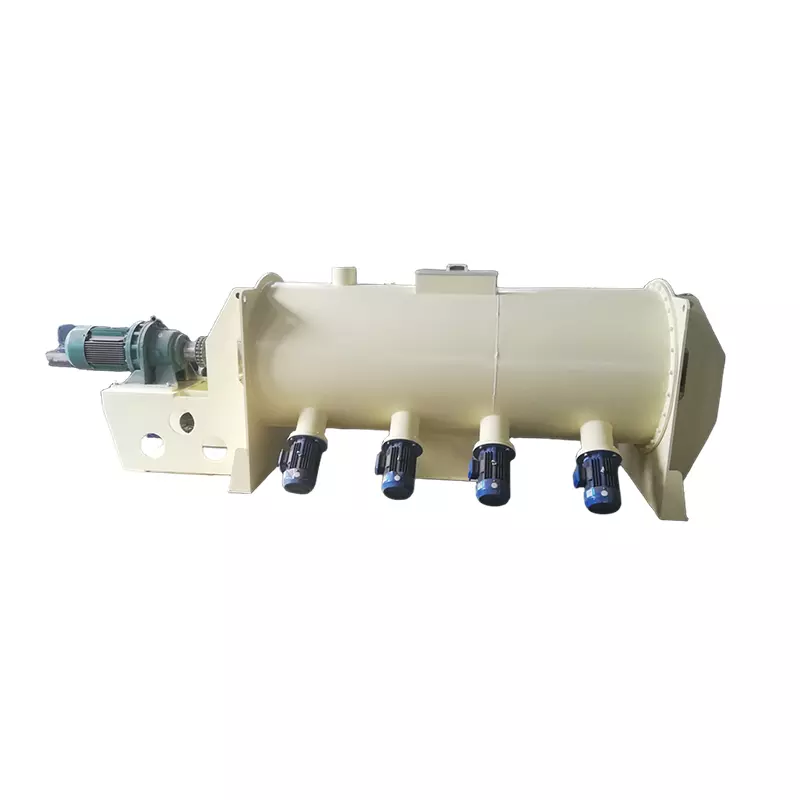
Product Description:
The plough-type mixer can handle the mixing of solid powders and granules, and is suitable for batch mixing processes with the addition of liquids. It is widely used in the food, chemical, and building materials industries. It is particularly significant in applications such as food additives, ready-mixed mortar, composting technology, sludge treatment, rubber and plastic, and special building materials. Its powerful cutting effect enables it to achieve high-performance mixing quality.
Technical Specifications:
The total volume of the equipment is 0.3 to 30 cubic meters.
Processing capacity per batch: 0.1 to 20 cubic meters
Each batch processes 0.3 to 15 tons of materials.
The mixing time used was between 3 and 15 minutes.
Drive configuration power: 3KW - 160KW
The material of the equipment can be 316L, 321, 304 or carbon steel.
Working principle:
The plough-type mixer is a single-axis forced mixing equipment. On the main shaft, there are multiple groups of plough-type mixers installed, and they are installed in a staggered and continuous manner. The structure avoids the formation of mixing dead zones. During operation, it generates an uninterrupted vortex centrifugal force. The staggered ploughs continuously stir the material, and the vortex centrifugal material flow continuously overlaps and disperses, causing the material to boil and forming a convection circulation. The material is rapidly stirred. Agglomerated materials such as fibers or materials that have become clumped due to moisture, or powder materials that have been condensed by adding liquid, are dispersed and separated by installing high-speed flying knives in the plough mixer. When combined with the convection circulation effect formed by the plough mixer's mixer blades during the material stirring process, the agglomerated materials are disintegrated and separated. The high-speed flying knives are installed at a downward 45-degree angle on the side of the plough mixer cylinder, with the knife heads extending into the cylinder. During the stirring process, the material is driven by the plough to the effective range of the flying knives, and is subjected to high-speed shearing by the flying knives.
Specification parameters:
1. Determine the volume of the mixed materials for each batch, ranging from 0.1 to 20 cubic meters, and select the corresponding specification of equipment.
2. Select the material for the equipment fabrication. The materials are classified as: the parts in contact with the materials, the parts not in contact with the materials, and the other components of the equipment retain the original material. The material is determined based on factors such as the properties of the materials, operating conditions, and hygiene level. Commonly, carbon steel, 304/316L/321 stainless steel materials are selected, and the surface treatment requirements are determined according to the requirements.
3. Determine the driving capacity based on the properties of the materials, such as specific gravity and fluidity, as well as the startup standards. The startup standards are: heavy-load startup and no-load startup.
4. Add auxiliary functional components based on the actual process conditions, such as liquid spraying, heating/cooling, etc.
5. Design the opening requirements of the equipment, such as the feeding port, cleaning port, exhaust hole, etc.
6. Select the discharging mode and driving method, including manual, pneumatic, and electric.
Important Note: The selection of equipment is a crucial step. Please provide as much detailed information about the materials and the process arrangement as possible, so that our professional staff can offer you high-quality technical services.